
Pleasure in words, a curiosity about them and an awareness, these seem important to us. Paying attention to individual words when we are reading, writing or moving about in the world is an important and interesting part of becoming a writer. Taking care over the words we choose makes a difference to what we say and the quality of our writing. It makes a difference to the quality of our thinking, too.
I remember, years ago, Michael Armstrong drawing attention to the metaphor of ‘delivery’ as it was beginning to be applied to teaching. Now it is easy, normal, even, to let ‘delivery’ spring to the tongue when talking about teaching a lesson. Do we really think of ourselves as arriving in school like a supermarket delivery service, with bags of groceries? It is not a good metaphor for teaching writing. What might be in the bags we carry in? And who will unpack them and how? We need to be conscious of the language we use. We need to listen carefully to how those in authority speak to us. We need to be aware that what we write can be open to interpretation, might be hurtful or affirming, just wrong, or just right. Even small words are interesting, like ‘just’.
We would like young writers to be on high alert for words and the way they work. ‘What does that mean?’ is an important question. We hear it often when we are reading in groups.
We are interested in the length of words; the way the number of syllables in a word can make a difference; the sound of words -combinations of sounds, sounds that unfailingly raise a laugh, sounds that soothe and reassure. We are interested in meanings and derivations. Where does that word come from? What is its root? And so, what other meanings reverberate when it is written? We are interested in exploring exotic words, words not in the English lexicon. We are interested in commonplace words. Sometimes it is worth pausing and thinking about the way a word like ‘if’ works; the difference between ‘a’ and ‘the’; the difference between ‘and’ and ‘but’; and what we mean when we say ‘enough’.
One resource that is easy to make and has endless applications is a word bank. Type up a grid of words. Print them, cut them, laminate them if you wish. Make collections of words that collocate, that gather round an idea or topic. Throw in unusual words, invented words, include synonyms and words that rhyme. You can make a very appealing word bank using cardboard packaging. Its colours and designs and the unexpectedness of the collection give rise to all kinds of invention. Once you have a collection of words, you can, alone or with others, sort them in any number of ways.
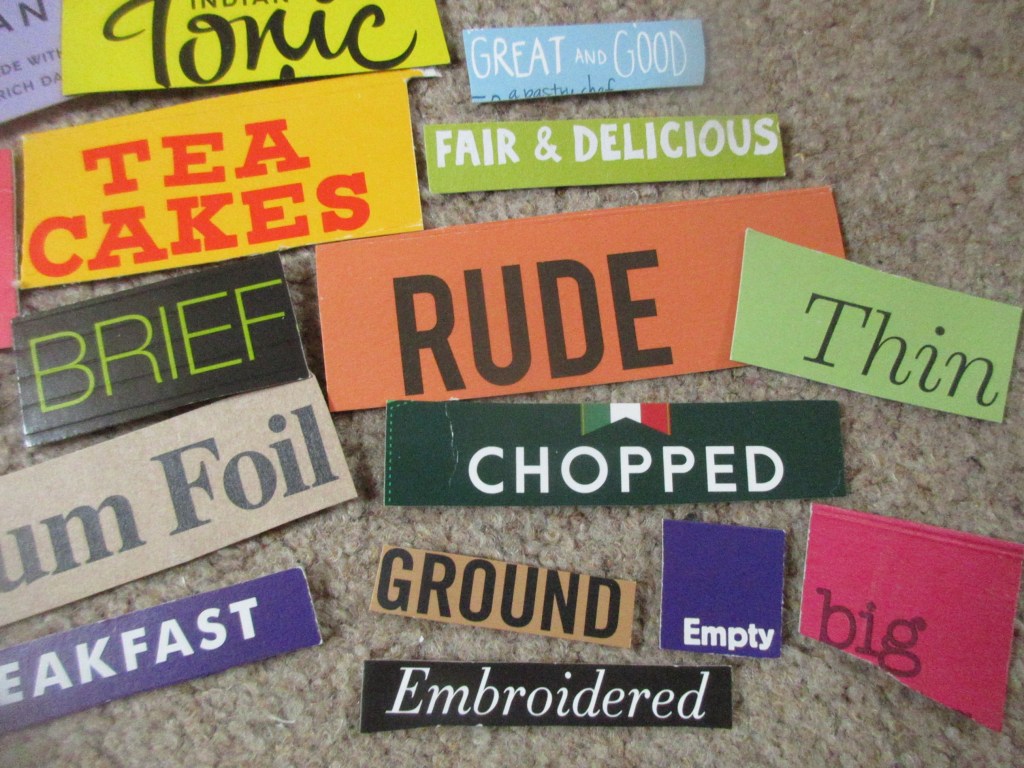
There are open and closed sorts. Closed sorts ask the sorter to sort according to given categories – words containing the same digraph, word classes and so on. These are more like tests. Open sorts, where the sorter defines their own categories, are much more fruitful in terms of interest and the learning that will take place.

Have a look at these fragments of word collections -bread and butter might be the start of a food category, but you could also have words ending in -er, and ask how does butter relate to sniffler and moaner? You could, if you wanted, spot the adjectives -and then you could hook them up with nouns – yes, here comes the noun phrase before you can say ‘aluminium foil’, and have the conversation about how aluminium is working there. Or you could invent new words and word combinations -what might ‘fiddly ink’ be, I wonder, or ‘heart wobble’, or ‘stick scrape? They may come in handy one day. You never know.
 Writing Box